.svg)
WPA Slave Narratives - The Federal Writers' Project (1936-1938)
What are they?
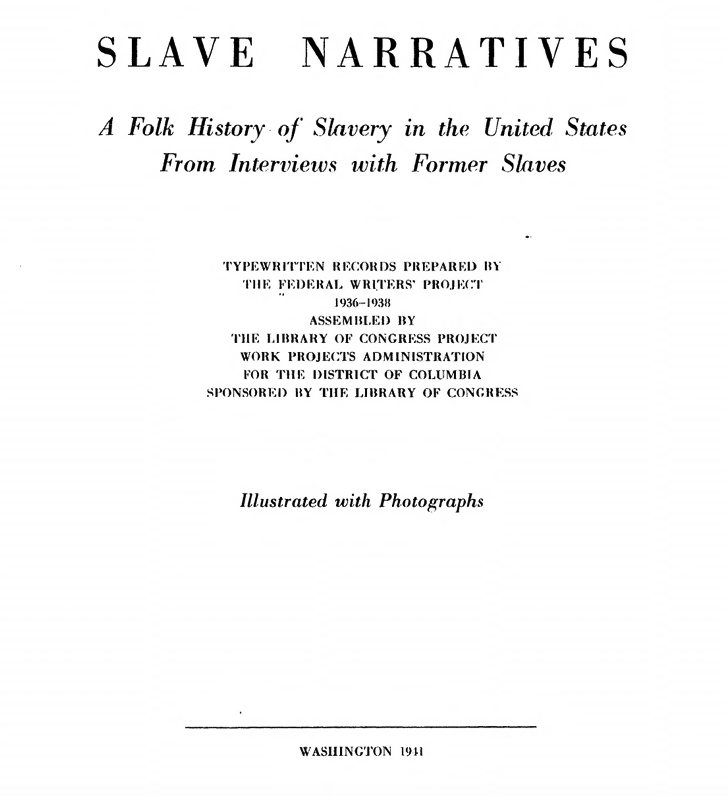
The WPA Slave Narratives are a collection of oral histories gathered from formerly enslaved people between 1936 and 1938 by the Federal Writers' Project (FWP), a division of President Franklin Roosevelt's Works Progress Administration (WPA).1 The resulting archive stands as the largest single collection of primary source testimony from individuals who lived under American slavery.2 The project produced more than 2,300 accounts, most of them first-person, along with over 500 black-and-white photographs of interviewees, compiled into seventeen bound volumes deposited at the Library of Congress in 1941.1
Interviewers were sent across seventeen states: Alabama, Arkansas, Florida, Georgia, Indiana, Kansas, Kentucky, Maryland, Mississippi, Missouri, North Carolina, Ohio, Oklahoma, Rhode Island, South Carolina, Tennessee, and Virginia. Their task was to document the life stories of surviving formerly enslaved people in their own words.1 Arkansas produced the largest volume of narratives of any state, with its nearly seven hundred accounts constituting almost one-third of the entire national collection.3 The full collection was organized alphabetically by interviewee within each state and deposited at the Library of Congress under the title Slave Narratives: A Folk History of Slavery in the United States from Interviews with Former Slaves.3 It was digitized in 2000–2001 with support from the Citigroup Foundation and is freely accessible online.1
Why were they comissioned?
The project grew out of two intersecting needs: an economic crisis and a historical emergency. The Great Depression had left large numbers of white-collar workers, including writers, journalists, and historians, unemployed. The WPA and its predecessor, the Federal Emergency Relief Administration (FERA), were designed to put such workers back to work on public-interest projects. The Federal Writers' Project was the branch of the WPA created to employ out-of-work professionals such as writers, journalists, folklorists, and anthropologists.
At the same time, the generation of people who had been enslaved was rapidly disappearing. Private collectors had made scattered efforts to document their experiences in the 1920s and early 1930s, but these were fragmentary.[3] John A. Lomax, National Advisor on Folklore and Folkways for the FWP, recognized the historical urgency when he received compelling ex-slave material from four early participating states: Florida, Georgia, South Carolina, and Virginia. In 1937 he directed all remaining states in the project to interview former slaves as well.
Editorial Control and Suppression of the Narratives
The FWP was not a centralized operation. It was a federal program administered through state offices, each with its own director, supervisors, and pool of interviewers. When an interviewer completed a session with a formerly enslaved person, the transcript went first to the state office. The state director reviewed, edited, and decided what to forward to the national office. The FWP's national director and his staff in Washington D.C. received only what each state chose to send. There was no independent mechanism for the national office to verify what had been collected or to detect what had been held back.
The Mississippi Suppression
The Louisiana Archive
"Some of those overseers were mean men. They wanted slaves to have babies bekase they wus valuable, so when a slave wus erbout to produce a baby, an he wanted her whipped, he had a hole dug in the groun' an' made her lay acrost it an' her han's and foots were tied, so she had to submit quiet like to the beatin' with a strop." - Rebecca Fletcher, 1940
Narratives from the Federal Collection:
Parts organized alphabetically by enslaved persons’ surnames.
- Alabama Volume I. Alternate Link here. Aarons - Young
- Arkansas Volume II
- Part 1. Alternate Link here. Abbott - Byrd
- Part 2. Alternate Link here. Cannon-Evans
- Part 3. Alternate Link here. Gadson - Isom
- Part 4. Alternate Link here. Jackson - Lynch
- Part 5. Alternate Link here. McClendon - Prayer
- Part 6. Alternate Link here. Quinn - Tuttle
- Part 7. Alternate Link here. Vaden-young
- Florida Volume III. Alternate Link here. Anderson - Wilson
- Georgia Volume IV.
- Indiana Volume V. Alternate Link here. Arnold - Woodson
- Kansas Volume VI. Alternate Link here. Holbert - Williams
- Kentucky Volume VII. Alternate Link here. Bogie-Woods (with combined interviews of others)
- Maryland Volume VIIII. Alternate Link here. Brooks - Williams
- Mississippi Volume IX. Alternate Link here. Allen-Young.
- Missouri Volume X. Alternate Link here. Abot-Younger
- North Carolina Volume XI
- Ohio Volume XII. Alternate Link here. Anderson-Williams
- Oklahoma Volume XIII. Alternate Link here. Adams-Young
- South Carolina Volume IVX
- Tennessee Volume XV. Alternate Link here. Batson-Young
- Texas Volume XVI
- Virginia Volume XVII. Alternate Link here. Virginia - Berry-Wilson
Narratives from the Louisiana Collection:


Attributions

Attributions
Attributions
Birth
Death
Resting Place
Language(s)
Spouse(s)
Partner(s)
Relatives
Connection(s)
Alma Mater
Influenced
Influenced By
Did You Know?
Colleague(s)
Collaborator(s)
Awards & Honors
Parents
Occupation
Certification(s)
License(s)
Education
Organization(s)
Appointment(s)
Notable Works
Notable Performances
Notable Moments
Military Rank/Branch
Years of Service
Political Affiliation
Genre(s)
Preceptors
Legacy
Thesis
Website


Stay Inspired Daily!
Sign up to receive daily notifications celebrating the achievements and contributions of Black women throughout history.
Cite
While every effort has been made to follow citation style rules, there may be some discrepancies. Please refer to the appropriate style manual or other sources if you have any questions.


